Facebook
 X
 Pinterest
 Copy Link
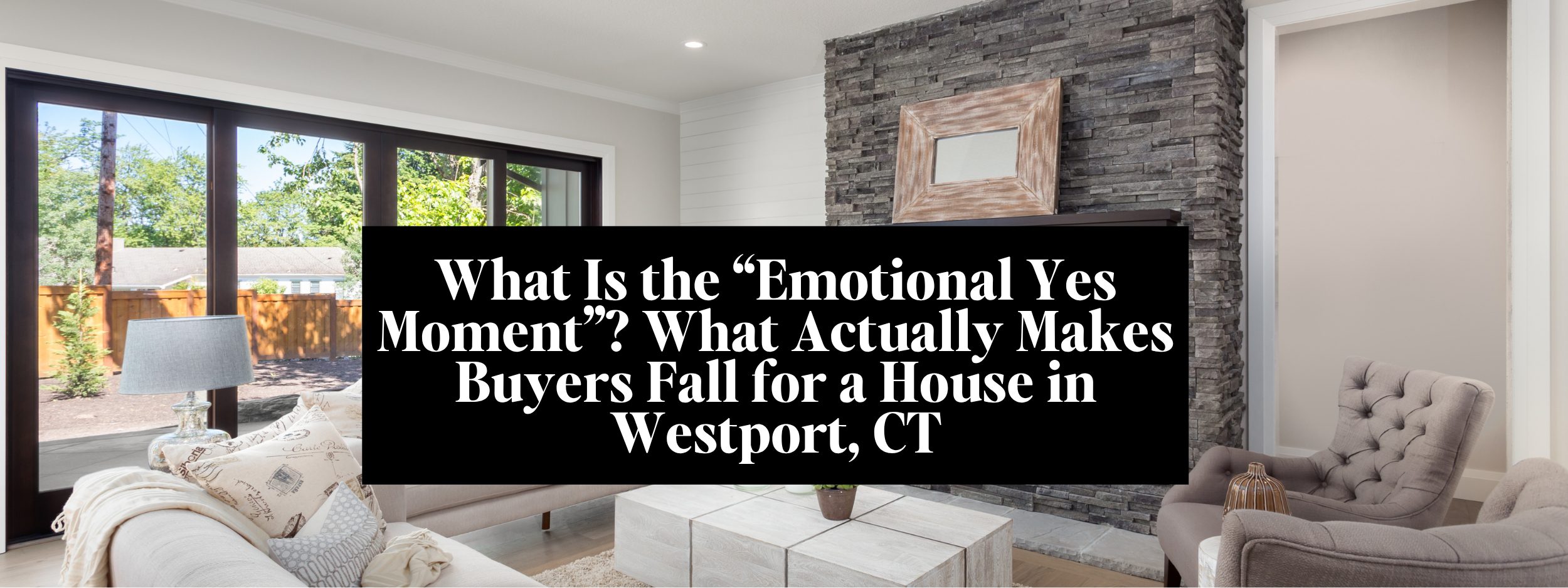
What Is the “Emotional Yes Moment”? What Actually Makes Buyers Fall for a House in Westport, CT
Published: July 27, 2026
Author: Lisa Stretton | Listing & Design Strategist | Real Estate Advisor @ Cindy Raney & Team, Coldwell Banker Realty
Location: Westport, CT · Fairfield County
Reading time: ~6 minutes
I’ve watched it happen from a kitchen doorway more times than I can count: a buyer stops walking mid-step, goes quiet for about three seconds, and says something like “oh – I could see us here.” That’s it. That’s the whole sale, decided in a room I didn’t even stage that morning. It just happened to have good light and nothing blocking the sightline out to the yard.
I call that the emotional yes moment, and it’s the thing every seller is actually trying to create – whether they’ve ever put a name to it or not.
What Is the “Emotional Yes Moment” in Home Buying?
It’s the specific instant during a showing when a buyer stops evaluating the house and starts picturing their life in it. Up until that point, they’re comparing square footage, running numbers, checking boxes. After it, they’re arranging furniture in their head. Agents talk about buyers “falling in love” with a house, but that’s vague – it’s really one moment, in one room, usually triggered by something specific: the way afternoon light hits a countertop, the quiet of a primary bedroom that doesn’t share a wall with anything, a sightline from the front door straight through to trees out back.
Ten years of designing interiors before I sold real estate taught me to notice exactly what causes that moment – and, just as usefully, what interrupts it.
What Actually Triggers That Moment for a Buyer?
Almost never the biggest, most expensive feature in the house. More often it’s one of these:
Light that isn’t fighting anything – no heavy drapery, no furniture blocking a window, nothing dimming a room that gets good natural light for part of the day.
A sightline that resolves somewhere pleasant – walk in the front door and your eye lands on a window, a staircase, a fireplace – not a hallway of closed doors.
Proportion that reads as generous even in a modest square footage – a kitchen island with room to actually walk around it, a primary bedroom that fits a bed and two nightstands without feeling like a squeeze.
Quiet, in the literal sense. Buyers register a house that doesn’t creak, hum, or carry noise between rooms as “well-built,” even when what they’re really responding to is insulation and door placement.
None of these show up on a spec sheet. All of them show up in the first ninety seconds of a showing.
Where Does the Emotional Yes Moment Usually Happen in a Home?
In Westport and Fairfield County listings specifically, I see it land in three places more than anywhere else: the kitchen – almost always tied to light and the island – the primary bedroom, when it feels like an actual retreat rather than a room that happens to have a bed in it, and the entry, in the first five seconds after the door opens, before a buyer has said a single word out loud.
If those three spaces aren’t doing their job, a house can still sell – but it usually takes longer, and it usually sells for less than a comparable house where at least one of them landed.
Can You Design a Home to Create That Moment on Purpose?
Yes – and this is where design and staging start to overlap. You’re not decorating for a buyer’s taste. You’re removing whatever is standing between the room and the moment: excess furniture that crowds a sightline, blackout curtains that were right for a teenager’s bedroom but wrong for a primary suite showing at 2pm, a kitchen table sized for the room you wish you had instead of the one you do.
This is also where sellers most often overspend in the wrong direction. A full kitchen renovation rarely buys the emotional yes moment – clearing the counters and fixing the lighting usually does. I’d rather a seller spend $1,500 on lighting and editing than $30,000 on cabinets a buyer will likely replace anyway.
What Kills the Emotional Yes Moment Before It Happens?
Clutter on a counter or nightstand – buyers see someone else’s life instead of picturing their own.
A blocked sightline – furniture, a rug, or a piece of art placed where the eye should be traveling freely.
Smell. This one gets overlooked constantly, and it ends the moment before it starts – pet odor, heavy air freshener trying to cover something, a musty basement smell drifting upstairs.
Dim or mismatched lighting – three different bulb temperatures in one room reads as neglected, even in an otherwise beautiful space.
The fix for most of these costs very little. It just requires someone who knows to look for them, which is most of what a pre-listing walkthrough with me actually is.
Frequently Asked Questions: The Emotional Yes Moment
Q: What is the “emotional yes moment” in real estate?
A: It’s the specific point during a showing when a buyer stops evaluating a house on paper and starts picturing themselves living in it. It’s usually triggered by light, sightlines, or proportion in one particular room – most often the kitchen, primary bedroom, or entry.
Q: Can staging create an emotional yes moment for buyers?
A: Staging can support it, but the moment itself usually comes from removing obstacles – clutter, blocked sightlines, poor lighting – rather than adding new furniture or decor. Editing tends to matter more than styling.
Q: Which room creates the strongest emotional reaction for home buyers?
A: In Westport and Fairfield County listings, it’s most often the kitchen, the primary bedroom, or the entry – the first five seconds after the front door opens.
Q: Do I need to renovate my kitchen to create this reaction in buyers?
A: Usually not. Lighting fixes and clearing counters tend to do more for this specific moment than a full renovation, which buyers may replace anyway.
Q: How do I know if my house is missing this moment during showings?
A: A pre-listing walkthrough with a design-trained eye will usually surface it quickly – it’s easier to spot in someone else’s home than your own, which is most of what that walkthrough is for.
Let’s Find Yours
Before you spend a dollar preparing your home, let’s walk it together. I’ll tell you honestly which room is closest to that moment already – and what’s standing in the way in the others.
Get a starting estimate on your home’s value: Home Valuation
Or reach out directly. I’ve walked homes all over Westport, Fairfield, Southport, Weston, and Wilton, and I’ll give you a straight answer about yours.
Lisa Stretton
Listing & Design Strategist | Licensed Real Estate Advisor
Cindy Raney & Team · Coldwell Banker Realty · Westport, CT
“Some agents market homes. I design them to sell.”
About the Author
Lisa Stretton is a Licensed Real Estate Advisor and Listing & Design Strategist with Cindy Raney & Team at Coldwell Banker Realty in Westport, CT. With 10+ years as a professional interior designer, Lisa brings a design-first eye to what actually gets a home ready to sell – separating what a buyer responds to emotionally from what simply reflects personal taste. She has helped sellers across Westport, Fairfield, Southport, Weston, Wilton, New Canaan, Darien, and Greenwich prepare homes that consistently outperform market expectations. Cindy Raney & Team has sold $800M+ in Fairfield County real estate.
Content is informational and does not constitute financial, legal, or contracting advice. All real estate content complies with NAR guidelines and the Fair Housing Act.


Podcast: Play in new window | Download
March 2026 Westport Market Snapshot

What March clarified — and how to read the Westport, CT real estate market right now
In Westport, March didn’t introduce a new direction in the housing market. It clarified how the market is functioning under continued constraint—and what it now requires to produce a successful outcome.
This is still one of Fairfield County’s most nuanced and segmented markets. And while monthly data offers signals, the real story lies in how buyers and sellers are behaving within limited supply.
The Executive Take (The Story)
March did not weaken the Westport real estate market. It revealed a shift in how consistently demand converts into results.
There were 18 closed transactions—enough to observe behavior, but not enough to rely on averages alone. What matters more is the pattern underneath:
- Inventory remains constrained
- Buyers are still active
- Outcomes are no longer uniform
Homes that aligned on pricing, condition, and presentation continued to sell quickly—often with strong competition. Others required more time, negotiation, or adjustment to reach the same result.
The question is no longer if a home will sell in Westport.
It’s how much friction it takes to get there.
The Constraint Driving Westport Right Now
Supply continues to define the Westport housing market.
- New listings declined significantly year-over-year
- Buyer choice remains limited
- Competition is concentrated—not universal
But scarcity alone is no longer enough to drive outcomes.
Instead, it is alignment that determines success.
When a home feels clearly positioned, buyers move quickly and decisively.
When it doesn’t, the process becomes slower, more negotiated, and less predictable.
Time is not what creates leverage in this market.
Clarity does.
How Westport Compares to Fairfield County
Across Fairfield County in March:
- Inventory declined
- Transaction volume increased
- Sale-to-list ratios remained strong
Westport followed this pattern—but expressed it differently.
Because of its depth and segmentation, Westport showed a wider range of outcomes:
- Strong competition at lower price points
- Selective movement in the mid-range
- Highly conditional liquidity at the top
This is not a uniform market—it’s a sorting mechanism.
What the March Data Really Shows
March activity in Westport breaks into three distinct behaviors:
1. Immediate Competition (Below ~$2M)
- Fast sales (often within days)
- Strong competition
- Frequent above-ask outcomes
Buyers here are decisive—and ready.
2. Negotiated Movement ($2M–$4M)
- More time on market
- Greater sensitivity to pricing
- Outcomes closer to (or slightly below) ask
Demand exists—but requires validation.
3. Conditional Liquidity ($5M+)
- Longer timelines
- Wider pricing outcomes
- Buyers requiring stronger justification
Luxury demand is still present—but far more selective.
What Matters (and What Doesn’t)
Some headline stats this month can be misleading.
- A dip in median price reflects what sold—not overall value
- Longer days on market reflect variation—not weakness
The real signal is behavioral:
- Buyers are still engaged
- Competition still exists
- Conviction is less immediate—and less consistent
What March Adds to the Bigger Picture
If January showed that pricing drives participation,
and February showed that alignment drives liquidity,
March adds a third layer:
Demand remains—but conviction is less durable.
Some homes moved quickly and cleanly.
Others required adjustment—even after strong initial interest.
This is not a softer market.
It’s a more selective and exacting one.
Guidance for Westport Sellers
If you’re considering selling in Westport:
- Price to attract conviction, not curiosity
- Prioritize presentation and preparation before launch
- Protect the first 7–10 days—early momentum matters more than ever
- Aim for depth of demand, not just one strong offer
In this market, testing pricing rarely improves outcomes.
Precision wins.
Guidance for Westport Buyers
For buyers navigating Westport:
- Move decisively when alignment is clear
- Stay engaged—even after losing a bidding situation
- Define value before entering negotiations
In a market where deals don’t always hold, opportunity can reappear.
Final Thought
The Westport, CT real estate market is still functioning—and still active.
But it is no longer uniform.
- Supply remains limited
- Demand remains present
- Outcomes are driven by alignment
Some homes sell quickly and competitively.
Others require time, adjustment—or both.
The difference isn’t the market.
It’s how clearly a home earns buyer conviction.
If you’re curious how these March trends apply to your home specifically—or where your property would sit within today’s Westport market—I’m always happy to share a thoughtful, data-backed perspective.
Should You Renovate or Sell As-Is in Westport? A Thoughtful Seller’s Guide

If you are considering selling your home in Westport, one of the most important decisions you will make is whether to renovate prior to listing or bring your property to market as-is. It is a nuanced question, particularly in a town where buyer expectations are high and presentation plays a significant role in both pricing and timing.
The answer is rarely absolute. Instead, it depends on a careful evaluation of your home, your goals, and what today’s Westport buyers are truly responding to.
Understanding the Westport Buyer
Westport continues to attract a sophisticated buyer, often relocating from New York City, who values both design and ease of living. These buyers are not simply purchasing square footage; they are investing in a lifestyle that feels complete from the moment they arrive.
As a result, homes that present as polished and move-in ready tend to command stronger offers and move more quickly through the market. At the same time, there remains a meaningful segment of buyers and builders actively seeking properties they can reimagine or rebuild.
This creates an interesting dynamic, where both renovated homes and as-is properties can perform well—if positioned correctly.
When Renovating Adds Meaningful Value
There are certain improvements that consistently resonate with buyers in Westport and can have a direct impact on your final sale price.
Kitchens and bathrooms remain the most influential spaces in any home. Buyers tend to make immediate judgments based on these areas, and even thoughtful, understated updates—such as refined finishes, updated fixtures, or a more contemporary palette—can significantly elevate perception.
In addition, cosmetic enhancements often provide an outsized return relative to their cost. Fresh paint in neutral tones, updated lighting, and well-maintained flooring can transform the overall feel of a home without requiring a full renovation. These changes help a property present as cared for and current, which is often all a buyer needs to feel confident moving forward.
Ultimately, creating a sense of “move-in readiness” is what many sellers are aiming for. In a market like Westport, where buyers are balancing demanding schedules and relocation timelines, convenience carries real value.
When Selling As-Is Is the More Strategic Choice
There are, however, situations where renovating prior to listing may not be the most effective use of time or capital.
If a home requires extensive work—such as a full kitchen renovation, structural updates, or significant layout changes—it is often more advantageous to price the property appropriately and allow the next owner to tailor it to their own vision. Westport has a strong appetite for renovation opportunities and new construction, particularly in desirable neighborhoods.
Location also plays a decisive role. A property situated near the town center, close to the train, or within a sought-after neighborhood may attract significant interest regardless of its current condition. In these cases, the intrinsic value of the land and setting can outweigh the need for immediate improvements.
There is also the consideration of timing and simplicity. For some sellers, minimizing disruption and bringing a home to market efficiently is the priority. In those instances, a well-priced as-is listing can still generate meaningful interest and competitive offers.
The Most Effective Approach: Strategic Preparation
What we are seeing most consistently in Westport is that the strongest results often come from a balanced approach.
Rather than undertaking a full-scale renovation, many sellers benefit from making targeted, cosmetic improvements and pairing those updates with professional staging and high-quality marketing. This allows the home to present at its best while avoiding the risks and costs associated with more extensive projects.
This level of preparation appeals to the broadest segment of buyers and often results in a more favorable combination of price and timing.
A More Nuanced Decision
The decision to renovate or sell as-is is not simply about condition; it is about strategy. It requires an understanding of how your specific property fits into the current market, what buyers in your price range expect, and where thoughtful improvements will truly make a difference.
In some cases, a measured investment can significantly increase your return. In others, restraint and precise pricing will yield a better outcome.
A Personalized Approach to Your Home
If you are weighing these options, the most effective next step is to evaluate your home in person and through the lens of today’s buyer.
I offer a private walk-through consultation where we assess your property together, identify which improvements—if any—will add meaningful value, and outline a clear plan for bringing your home to market with intention.
It is a tailored, thoughtful process designed to help you make confident decisions and achieve the strongest possible result in Westport’s competitive market.
What is the Luxury Market Like in Westport, CT?

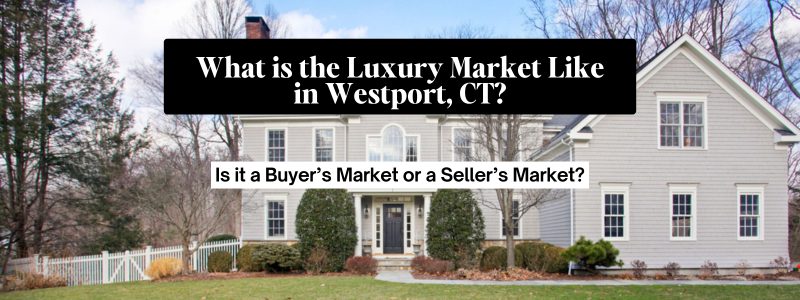
What Is the Luxury Market Like in Westport, CT — Is It a Buyer’s or Seller’s Market?
If you’ve been following the luxury real estate conversation in Westport, you’ve likely heard mixed opinions. Some headlines suggest inventory is rising. Others hint that buyers have more power. But on the ground, the story is far more nuanced — and far more local.
Here’s the truth: there has not been a dramatic increase in luxury homes for sale in Westport, and buyer demand continues to exceed supply.
Limited Inventory Is Still Defining the Market
Despite a bit more movement than we saw at the tightest points of the market, Westport luxury inventory remains constrained. Many homeowners with ultra-low interest rates are staying put, and truly special properties — those with strong locations, privacy, updated interiors, and lifestyle-driven layouts — are still rare.
That imbalance keeps the market competitive. When the right home becomes available, buyers are paying attention — and acting.
Demand Is Still Strong — Just Smarter
Luxury buyers today are intentional, not hesitant. They’re educated, prepared, and value-driven. They want homes that make sense for how they actually live: flexible spaces, great light, modern amenities, and proximity to town, schools, or the water.
What they aren’t doing is overpaying for homes that miss the mark. Condition, layout, and pricing matter more than ever — but strong homes are still commanding real interest and strong outcomes.
What This Means for Sellers
For sellers, this remains a favorable market — if strategy leads the way. With demand outpacing supply, well-priced homes that show beautifully continue to perform. Multiple-offer scenarios still happen, especially in prime price points and locations.
However, pricing “aspirationally” without market support can stall momentum. Today’s buyers are confident enough to wait — and informed enough to know when a home is overpriced.
What This Means for Buyers
For buyers, opportunity exists — but patience alone isn’t a strategy. Inventory is selective, not abundant. When the right property appears, decisiveness matters. The ability to recognize value and move with confidence is often what separates success from disappointment.
So… Buyer’s or Seller’s Market?
Westport’s luxury market is best described as supply-constrained with sustained demand. It rewards sellers who price thoughtfully and buyers who are prepared and well-advised.
In markets like this, outcomes aren’t accidental — they’re planned. And the right guidance makes all the difference between watching from the sidelines and moving forward with clarity and confidence.